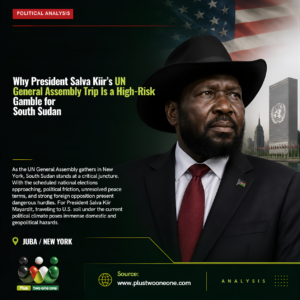
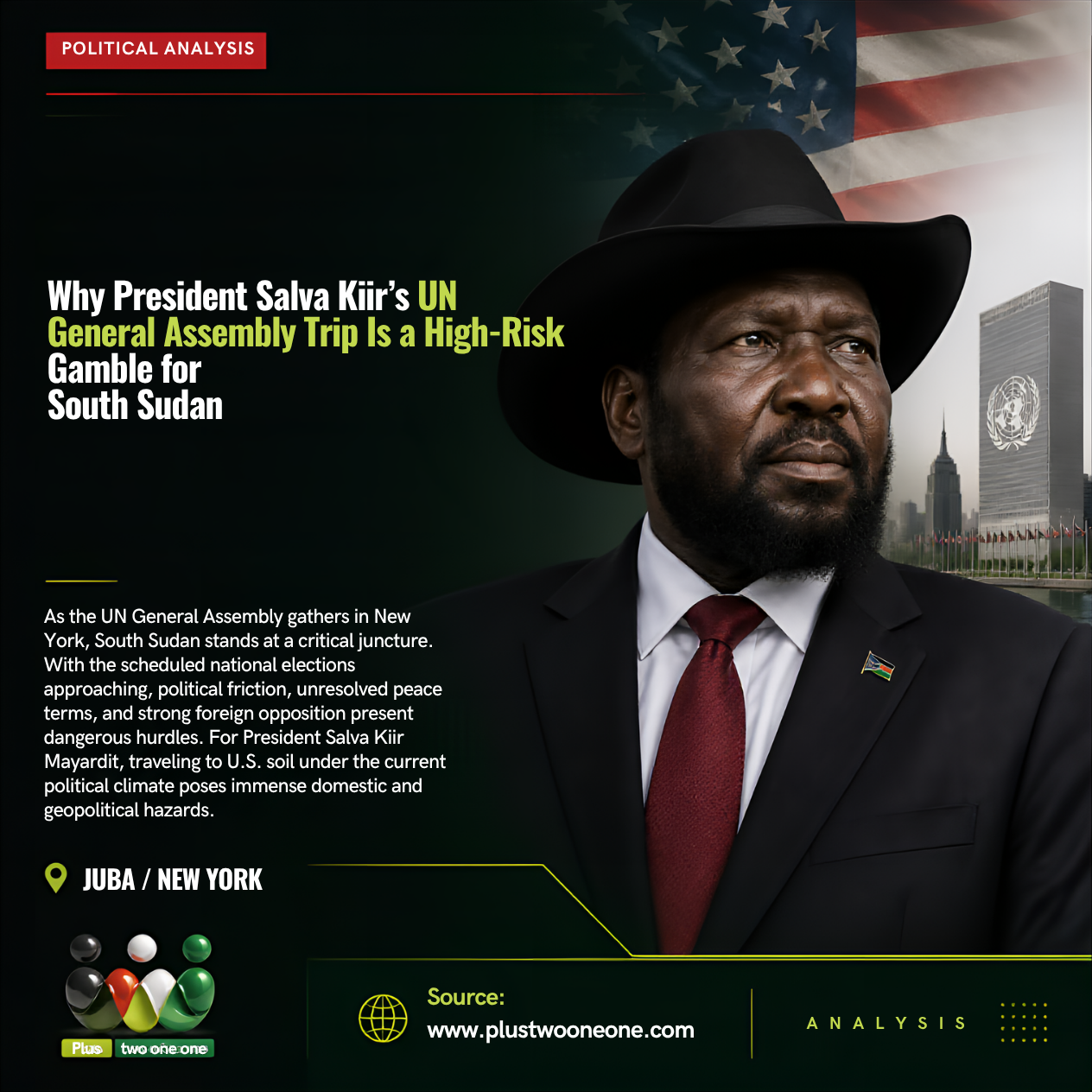
As the United Nations General Assembly convenes in New York, South Sudan is approaching a politically sensitive crossroads. With elections on the horizon, key provisions of the peace process still unresolved, political tensions remaining high, and disagreements with international partners continuing, every decision by the country’s leadership carries significant consequences.
Against this backdrop, President Salva Kiir Mayardit’s proposed trip to the United States deserves careful strategic consideration. The central question is not simply whether South Sudan should be represented at the UN General Assembly, but whether the President himself needs to make the journey at a moment when the country faces substantial political and security challenges at home.
1. Washington and the Risks of a Difficult Diplomatic Environment
Relations between Juba and Washington remain complicated, particularly over questions surrounding South Sudan’s political transition and electoral timetable.
Traveling to the United States places the President directly within a diplomatic environment where disagreements with the South Sudanese government could receive heightened attention. Concerns about sanctions, diplomatic pressure, legal complications, or other forms of political confrontation may therefore warrant consideration.
This does not mean that detention or other extreme measures are inevitable. Rather, the broader point is one of strategic prudence: when relations with a powerful host government are strained, unnecessary exposure to additional risks should be carefully weighed against the diplomatic benefits of personal attendance.
The Alternative: Let South Sudan Be Represented Without Moving the Presidency
For Plus Two One One, the strategic option is straightforward: South Sudan does not need to be absent from the UN General Assembly simply because the President remains in Juba.
President Salva Kiir could remain in the capital to concentrate on domestic stability, the implementation of the peace process, security, and preparations for the country’s political transition.
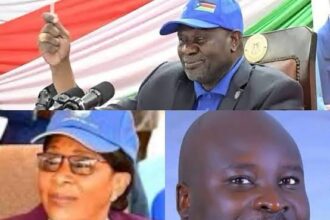
Meanwhile, the Minister of Foreign Affairs, Hon. Morgan Pitia, could lead South Sudan’s delegation to the United Nations General Assembly and present the country’s positions to the international community.
Such an arrangement would preserve South Sudan’s diplomatic presence while maintaining executive continuity at home.
The country can send its voice to New York without necessarily sending its presidency there.
For Plus Two One One, keeping President Kiir in Juba while delegating the UN mission would provide an opportunity to balance international representation with domestic political stability—and ensure that the country’s leadership remains focused on the challenges directly affecting South Sudan’s future.