
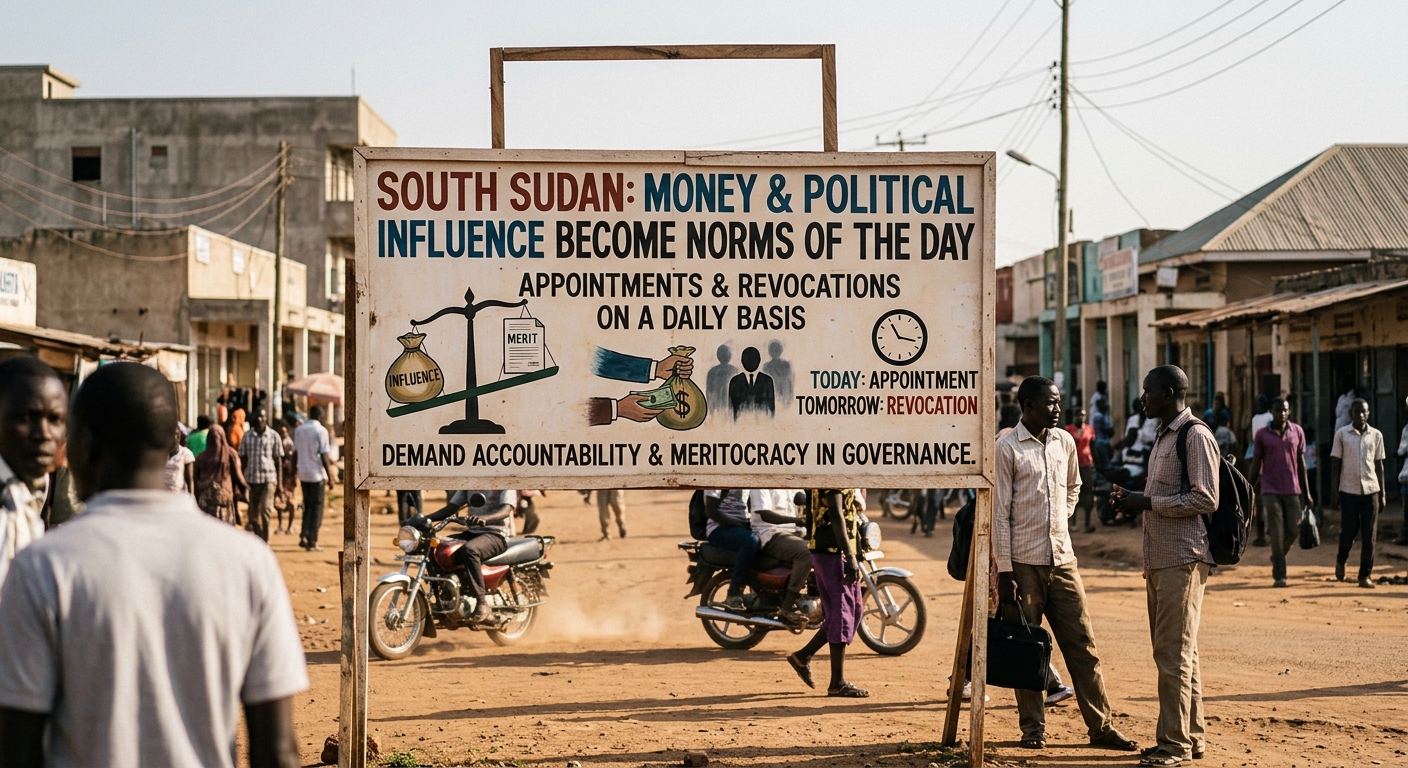
When Politics Becomes a Marketplace: The Growing Culture of Lobbying, Appointments and Revocations in South Sudan.
South Sudan’s presidency is confronting a growing governance concern: the perception that political lobbying, personal loyalty and access to wealth are becoming more influential than competence, institutional rules and the public interest in determining who occupies positions of power.
For a country born out of a long liberation struggle and founded on aspirations of self-government, presidential appointments should strengthen institutions, improve public administration and deliver services to citizens. Instead, the repeated appointment, dismissal and reappointment of ministers and senior officials has increasingly created the impression of a government in which political connections matter more than institutional continuity, professional competence and coherent policy objectives.
This is not simply a question of whether a particular minister deserves to remain in office. It is a question about the system that emerges when public positions become objects of political competition.
The Presidency and the Politics of Access
Presidential power in South Sudan is exceptionally consequential. The President exercises enormous influence over the appointment and removal of ministers, governors, senior security officials and other public officials. As a result, access to the presidency can translate into substantial political and economic influence.
Recent reporting has intensified concerns about political lobbying within the presidency. In November 2025, Radio Tamazuj reported a series of senior changes within President Salva Kiir’s office amid concerns about corruption and political lobbying. The publication quoted a Juba-based policy analyst who argued that lobbying had increasingly become focused on placing individuals in positions from which they could personally benefit rather than advancing sound public policy.
That observation points to a broader institutional problem. When political actors compete primarily for appointments, the ministry or institution itself can become secondary to the struggle over who controls it.
The Ministry of Finance: A Revolving Door
Perhaps the clearest example is the Ministry of Finance and Planning.
According to Reuters, the dismissal of Finance Minister Athian Diing Athian in November 2025 marked the eighth change in the finance portfolio since 2020. Athian had served for just over two months before being replaced by Barnaba Bak Chol, who had previously served as finance minister before being removed in 2024.
Such instability is particularly troubling because the Ministry of Finance sits at the centre of national economic management. It oversees the national budget, public expenditure, revenue and broader fiscal policy.
If ministers are repeatedly removed before they have sufficient time to implement policies, citizens are entitled to ask whether the ministry is being managed according to a coherent economic strategy—or according to shifting political calculations.
An analyst quoted by Eye Radio in 2024 warned that frequent changes in economic ministries undermine policy implementation and can increase corruption risks because officials who fear sudden dismissal may have incentives to extract as much personal benefit as possible while they remain in office.
The problem, therefore, is not simply that ministers are changed. The deeper problem is that constant uncertainty can create a political environment in which short-term survival takes precedence over long-term public administration.
Petroleum: Politics Around the Country’s Most Important Resource
The Petroleum Ministry provides another striking example.
In November 2025, President Kiir dismissed Undersecretary Deng Lual Wol and reinstated Chol Thon Abel. Reuters reported that this represented the fourth switch between the two officials in less than two months. The reshuffling also affected the leadership of Nilepet, the state oil company.
This matters because oil remains the backbone of South Sudan’s formal economy. The Petroleum Ministry and Nilepet therefore occupy strategic positions at the centre of the country’s most important source of public revenue.
When leadership of institutions responsible for such resources changes repeatedly, legitimate questions arise about who benefits from those changes, what interests are being served, and whether institutional decisions are being driven by national policy or political influence.
It would be irresponsible to claim, without evidence, that every appointment or dismissal results from a financial transaction. But the frequency of these changes creates a legitimate governance concern: when public offices become unstable, the incentives for political actors to compete for access to those offices become stronger.
Justice, Education and Trade: Ministers Removed Without Explanation
The pattern is not confined to economic ministries.
In March 2025, President Kiir dismissed three ministers: Awut Deng Acuil from General Education, Ruben Madol Arol from Justice and Constitutional Affairs, and Joseph Mum Majak from Trade and Industry. No official explanation was provided for the dismissals.
These ministries are central to the functioning of a modern state.
The Ministry of General Education develops policies affecting millions of children and teachers. Justice and Constitutional Affairs is fundamental to the rule of law and constitutional governance. Trade and Industry is critical to economic development, investment and private-sector growth.
Leadership instability in these institutions can therefore have consequences far beyond political circles in Juba. It can disrupt policy implementation, weaken institutional memory and make long-term planning increasingly difficult.
Transport, Mining and Other Institutions
The turnover has also extended to senior administrative positions below the ministerial level.
In December 2025, President Kiir replaced the undersecretaries of the Ministries of Transport and Mining, while also changing the leadership of the Financial Intelligence Unit and the South Sudan Civil Aviation Authority.
The significance of these changes lies not necessarily in any individual appointment, but in their cumulative effect.
A government can absorb an individual ministerial change. It becomes far more difficult to build effective institutions when senior personnel across multiple ministries, agencies and regulatory bodies are repeatedly replaced.
Strong institutions require continuity, professional expertise and predictable procedures. Constant personnel changes undermine all three.
Appointment and Revocation as Instruments of Political Control
South Sudan’s challenge is therefore larger than the question of whether individual appointees are qualified.
The deeper concern is the emergence of a political culture in which appointment itself becomes a form of political currency.
An official who receives a presidential appointment gains authority, access and influence. An official who loses that appointment can suddenly lose all three. This creates powerful incentives for politicians and aspiring officials to cultivate relationships within the presidency rather than build credibility through professional performance and institutional service.
The result can become a vicious cycle:
lobby for appointment → obtain office → build political networks → protect access → compete against rivals → face dismissal → lobby for another appointment.
Over time, such a system risks transforming public administration into political patronage.
An opinion analysis published by Radio Tamazuj in 2025 described the repeated use of presidential decrees as part of a political marketplace in which public offices can become associated with loyalty and access to resources. It also highlighted the repeated rotation of officials, including the extraordinary turnover within the Finance Ministry.
Money and Political Influence
The allegation that “money talks” must be treated with particular care. Claims that a specific appointment was purchased should not be presented as fact without documentary evidence or credible investigative findings.
Nevertheless, there are broader reasons for concern.
Reuters reported in 2025 that the United States sanctioned Benjamin Bol Mel, a businessman who became a senior political figure close to President Kiir, over alleged corruption-related activities involving construction firms. The reporting also referred to allegations concerning business interests associated with members of Kiir’s family, while making clear that Kiir himself was not named on the corporate documents cited in the investigation. Kiir’s office rejected the allegations concerning his family as a political witch-hunt.
These controversies demonstrate why the boundary between political influence, private business interests and public office must be exceptionally clear—particularly in a country where institutions remain fragile.
The answer cannot be to assume that every politically successful individual is corrupt. The answer is to build institutions in which even the appearance of buying political influence is difficult to sustain.
The Cost to the Country
The consequences of political patronage extend far beyond the corridors of the presidency.
First, institutional memory disappears. New officials are repeatedly required to learn systems and procedures that their predecessors may only recently have begun to understand.
Second, policy implementation suffers. A minister who believes that he or she could be dismissed at any moment may be less willing to pursue difficult reforms, particularly reforms that threaten established interests.
Third, corruption risks increase. Where tenure is uncertain, officials may become more focused on building personal networks and securing their political future than on protecting public resources and strengthening institutions.
Fourth, public trust declines. Citizens may increasingly conclude that government positions are reserved for people with political connections rather than those with the competence required to perform public duties.
Finally, national cohesion is placed at risk. If communities perceive that appointments systematically favour particular political, regional or ethnic networks, state institutions can become another arena for competition between groups.
Recent reporting has already raised concerns about the regional and ethnic balance of appointments to government institutions.
A Presidency Cannot Become a Marketplace
The presidency should be the centre of national leadership, not the centre of a permanent contest for patronage.
South Sudan needs a system in which ministers are appointed because they can deliver measurable results, not because they have the strongest political lobby. Senior officials should be removed for clearly stated reasons, not simply because another political faction has become more influential. When dismissals occur, the public deserves an explanation.
The country also needs stronger parliamentary oversight, transparent appointment procedures, enforceable conflict-of-interest rules and meaningful disclosure of public officials’ financial interests.
Most importantly, South Sudan needs to move away from a political culture in which the presidential decree is treated as the primary mechanism for managing the state.
A government cannot build strong institutions if every institution remains vulnerable to political turbulence at the top.
The Choice Before South Sudan
The growing culture of political lobbying in and around the presidency should therefore be treated as a national governance issue, not merely an internal matter within the ruling establishment.
The question is not whether President Kiir has the constitutional authority to appoint and dismiss officials. The question is how that authority is exercised and what kind of political culture it produces.
South Sudan can have strong presidential leadership and still build institutional government. It can accommodate political competition without turning ministries into political prizes. It can recognize political loyalty without sacrificing competence.
But that requires a clear distinction between political authority and public administration.
If appointments continue to be perceived as political rewards, dismissals as political punishment, and access to the presidency as a gateway to wealth and influence, the state risks becoming weaker even as the number of government decrees increases.
South Sudan does not need fewer ministers merely for the sake of having fewer ministers. It needs predictable institutions, transparent appointments, accountable leadership and a political culture in which public office is understood as a responsibility—not a prize.
That is the real test of South Sudan’s presidency: not how many officials it can appoint or dismiss, but whether it can build institutions that remain stronger than the political interests of the individuals temporarily occupying them.