
How a Former Musician Became a Loud Voice in the Movement’s Internal War
JUBA Let us stop pretending that the SPLM-IO crisis is merely a disagreement between political colleagues.
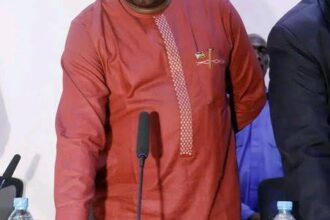
The movement is being eaten alive by mistrust, factionalism, personal ambition and a ruthless struggle for control. And in that ugly contest, K-Deng has emerged as one of the loudest voices defending the loyalist camp and attacking those on the other side of the divide.
K-Deng was once known primarily as a musician. He later became involved in the Nuer armed rebellion in South Sudan. Today, he is operating in a very different arena, the brutal internal politics of the SPLM-IO.
The question is who benefits from what he is doing now.
A voice that found a political battlefield
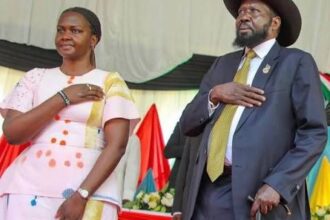
There are proof within SPLM-IO circles that K-Deng has been encouraged and politically backed by Angelina Teny the wife of the former 1st vice president Dr. Riek Machar, to attack internal opponents and defend her loyalist faction including Hon. Regina Kapa.
SPLM-IO Politics is measured by who is given a platform, whose interests are advanced, who is attacked, and what the political outcome becomes.
Currently the only outcome is shooting the movement in the face.
deeper division.
The SPLM-IO already has rival factions, competing claims to leadership and competing political structures. The United Nations has described the detention of Riek Machar as contributing to further fracturing of the movement, while Stephen Par Kuol’s faction separated from Machar’s camp and pursued a different political course.
In June 2026, the Political Parties Council formally registered the breakaway faction as the IO Party. Machar’s faction rejected that registration, illustrating just how deep the institutional dispute has become.
It is gasoline on a burning house.
The inner circle problem
The uncomfortable issue is bigger than K-Deng.
The SPLM-IO officially lists Riek Machar as chairman and Angelina Teny as a member of its Political Bureau.
But the movement faces a persistent perception problem, that political power is increasingly concentrated around personalities and their loyal networks rather than protected by institutions.
That is why critics speak of an “IO royal family.”
The phrase is politically loaded, but the underlying question is legitimate:
Can a movement that claims to be fighting for democratic transformation tolerate a political culture in which personal loyalty becomes more important than institutional accountability?
That question cannot be answered with slogans.
It requires the leadership to demonstrate that the movement belongs to its members not to an inner circle of royalists.
K-Deng must answer for his political involvement in SPLM-IO affairs.
If K-Deng is acting independently, then he should say so and defend his political record without hiding behind anyone.
If he is receiving political backing, then he should explain where that backing comes from.
And if powerful figures are using junior political actors to fight battles they do not want to fight themselves, then those figures should step into the open.
Own the fight. Own the accusations. Own the consequences.
Political leaders should not send “k-dengs” surrogates into the trenches and then wash their hands of the political damage, that is not courage, it is political outsourcing.
The question nobody wants to ask
If K-Deng’s political campaign is genuinely intended to defend and strengthen the SPLM-IO, then there is one unavoidable test:
What has it produced?
More unity?
More trust?
A stronger political structure?
A broader coalition?
Or simply another layer of hostility?
Because a movement already fractured into rival camps does not need more people perfecting the art of political provocation.
It needs people capable of rebuilding trust.
The SPLM-IO’s problem is not a shortage of voices.
It is a shortage of institutional discipline.
Stop using people as political ammunition
South Sudan has seen this movie before.
A powerful politician finds a loyalist.
The loyalist attacks an opponent.
The opponent retaliates.
The faction closes ranks.
Another faction forms.
The movement splits.
Then everyone claims they were defending the revolution.
Eventually, ordinary members are left standing in the ruins while the political elites negotiate their next arrangements.
That cycle must end.
If K-Deng has chosen to become a political combatant, he has every right to participate in politics. But political participation comes with responsibility.
He cannot demand the privileges of political influence while escaping scrutiny for the consequences of his interventions.
The same applies to Hon. Angelina Teny, Regina Kaba and anyone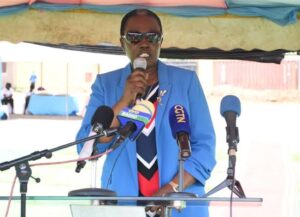
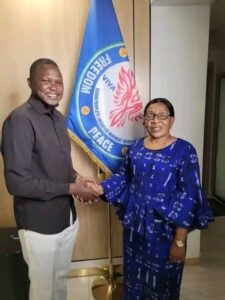
 standing behind him.
The SPLM-IO cannot survive as a family affair
The movement’s members deserve better than politics built around personal loyalty.
They deserve structures that can survive disagreement.
They deserve leaders who can tolerate criticism.
They deserve internal mechanisms for resolving disputes without turning every disagreement into a factional war.
And they deserve politicians who understand that a movement cannot be strengthened by destroying everyone inside it who refuses to kneel.
The SPLM-IO’s current fragmentation is already serious enough. Its rival factions have demonstrated that the old structure is under enormous strain.
The last thing it needs is another generation of political operators learning that their quickest route to relevance is attacking fellow opposition figures.
The brutal truth
K-Deng may be the loudest voice in this particular political fight.
But he is not the whole story.
The real story is a political culture that turns loyalty into currency and disagreement into war.
If K-Deng is acting independently, let him defend his record.
If he is being politically sponsored, let his sponsors come forward.
If nobody is directing him, then the movement must still confront the consequences of the politics he represents.
Because the outcome remains the same:
the SPLM-IO is spending precious political capital fighting itself.
That is not a victory.
That is political bankruptcy.
The movement was supposed to challenge a system.
It should not become another example of the system it claims to oppose.
And here is the hardest truth of all:
A movement does not need an enemy outside its gates when its own leaders are handing political ammunition to people inside the house.
The SPLM-IO does not need more attack dogs.
It needs institutions.
It needs accountability.
It needs political maturity.
And above all, it needs leaders who understand that you can win every internal argument and still lose the movement.